
You’re comparing portable power stations, and every listing seems to answer a different question. One emphasizes battery capacity. Another advertises impressive output. A third shows a refrigerator beside the unit without making clear how long it will run.
You want something simpler: enough backup power for the devices that matter during an outage.
The size you need depends on three things: the power your devices require together, the energy they need over time, and compatible connections. Battery capacity alone can’t answer all three.
You don’t need to plan backup for your entire home. Start with a few essentials and a realistic operating period. Here’s how to turn those choices into buying requirements—and recognize the details worth checking before you pay.
Why Choosing by Battery Size Can Go Wrong
Portable power stations have two prominent specifications that beginners can easily confuse.
Watts describe power: how much a device needs at a given moment, or how much a power station can supply.
Watt-hours describe energy: an amount stored in a battery or consumed over time.
A unit might hold enough energy for your intended use but lack the output needed to operate an appliance. Another might run that appliance successfully but exhaust its battery sooner than you expect.
Connections introduce another requirement. Having several outlets doesn’t establish that every connected device will receive the supply it needs.
That’s why choosing the biggest battery within your budget can still produce a poor match. First establish the job, then assess the specifications.
1. Define One Useful Outage Scenario
“Backup power for blackouts” is too broad to calculate.
A more useful goal identifies the exact equipment and operating period: keeping a particular desk lamp and fan running through an evening interruption, for example, with enough energy for limited phone charging.
Choose a scenario that reflects what you actually want to preserve. Then decide:
- Which exact devices are essential?
- How long does each need power?
- Which will operate together?
- Which tasks can reasonably happen at different times?
Keep conveniences separate initially. Adding an appliance may change both output and capacity requirements.
Also consider whether powering a device preserves its intended function. A router with backup power won’t guarantee internet access if other required equipment or the provider’s network is unavailable.
Critical medical equipment needs equipment-specific guidance from its manufacturer and relevant healthcare provider. It shouldn’t be treated as an ordinary addition to a general household calculation.
2. Establish Your Combined Running Demand
Find the requirements of the equipment you actually own. Use model-specific manufacturer information, manuals, and suitable measurements where available.
Avoid substituting the requirements of something that merely looks similar.
Add the devices that will run together
Suppose, using illustrative figures, you want to operate:
- A 12-watt lamp.
- A fan drawing 28 watts at your intended setting.
- A device drawing 10 watts while charging.
If all three operate together, their combined running demand is 50 watts.
The power station needs suitable continuous output for that combination. You’ll also need to check any applicable limits on individual outlets, ports, or shared outputs.
Understand what the label describes
A charger’s maximum output isn’t necessarily the device’s constant consumption. A laptop may draw different amounts depending on its activity and battery state.
Keep those distinctions visible. A maximum rating can be useful, but it shouldn’t quietly become a claim about normal energy use.
If a requirement remains unknown, identify it as unknown rather than disguising the gap with a precise-looking total.
3. Check Startup Requirements Separately
Some equipment briefly needs more power when starting than it uses during normal operation.
That starting demand can determine whether a power station is suitable. Motor-driven appliances deserve particular attention, although requirements vary by design.
A candidate’s continuous output rating doesn’t necessarily establish startup compatibility. Its advertised surge rating also needs context: how long that output is available, under what conditions, and whether it suits the appliance’s starting behavior.
Don’t apply the same startup multiplier to every appliance. Seek equipment-specific information where it matters.
Remember that cycling equipment can restart automatically while other devices are operating. A setup that works only when everything is switched on in a carefully controlled order may be unsuitable for everyday use.
4. Estimate How Much Energy You Need
For a steady load, use this relationship:
Watts × hours = watt-hours
A 12-watt lamp operating for five hours uses 60 watt-hours. A 28-watt fan operating for three hours uses another 84 watt-hours.
Together, those planned uses require 144 watt-hours at the devices, before other tasks are included.
Their combined running demand while operating together is 40 watts. Their energy requirement is 144 watt-hours across the stated periods. These are different requirements.
Handle changing loads carefully
Cycling appliances don’t necessarily draw their running power continuously. Suitable energy measurements over a representative period may be more useful than a momentary watt reading.
Conditions still matter. Measurements from one temperature or operating setting may not represent another.
Phone charging also changes as the battery fills. Multiplying a charger’s maximum rating by the full outage period can misrepresent the task.
Where reliable information is missing, keep the estimate qualified.
5. Allow for Usable Capacity and Operating Conditions
Advertised battery capacity isn’t automatically the energy available at your devices.
The power station consumes some energy itself. Conversion losses, operating conditions, battery protection limits, and the output used can affect delivery.
For a steady load, a useful starting relationship is:
Usable energy at the relevant output ÷ device demand = estimated runtime
The challenge is establishing a suitable usable-energy figure.
Look for manufacturer information that relates to your intended load and connection. A runtime example for different equipment may offer context without settling your calculation.
Small AC loads deserve attention because keeping the inverter operating has an energy cost. Some units also have low-load shutdown settings that could interrupt a modest demand.
Avoid applying an unexplained universal percentage. Allowances should address identifiable uncertainties, such as variable consumption or a longer operating period.
6. Confirm the Connections
A socket that physically accepts a plug doesn’t establish complete compatibility.
Check that AC output voltage and frequency suit the equipment and market. Where the appliance specifies supply characteristics, confirm those too.
For USB charging, establish the required charging capability and suitable cable. A USB-C port alone doesn’t prove that it can supply the power a particular laptop needs.
Also check whether using several ports changes the power available to each.
For DC connections, voltage, polarity, current capability, connector dimensions, and manufacturer approval matter. Don’t improvise because two connectors appear to fit.
Use approved direct connections to individual devices. Connecting a power station to household wiring requires a transfer switch or interlock installed by a licensed electrician; never attempt to feed electricity into a household wall outlet (backfeeding). In a life-threatening emergency in the United States, call 911.
How to Recognize a Suitable Match
Compare each shortlisted unit against the same household job. Give each important requirement one of three judgments:
- Meets it: supported by relevant information.
- Doesn’t meet it: a documented limitation rules it out.
- Needs confirmation: the evidence doesn’t answer the question.
That third judgment prevents missing information from becoming an assumption.
Check practical fit as well. Can you manage the weight? Does the intended location meet manufacturer requirements? Are controls accessible, and are the necessary charging accessories included?
Treat special high-output modes carefully. They may have restrictions and shouldn’t automatically replace the normal continuous rating in your decision.
If a material question remains, ask the manufacturer about the exact models and intended combination. Separate “Will it start?” from “How long will it run?” A general answer about capability may not address both.
Go Further With Backup Power Without Guesswork
These checks provide a useful starting point. Applying them consistently is what turns a confusing shortlist into a decision you can explain.
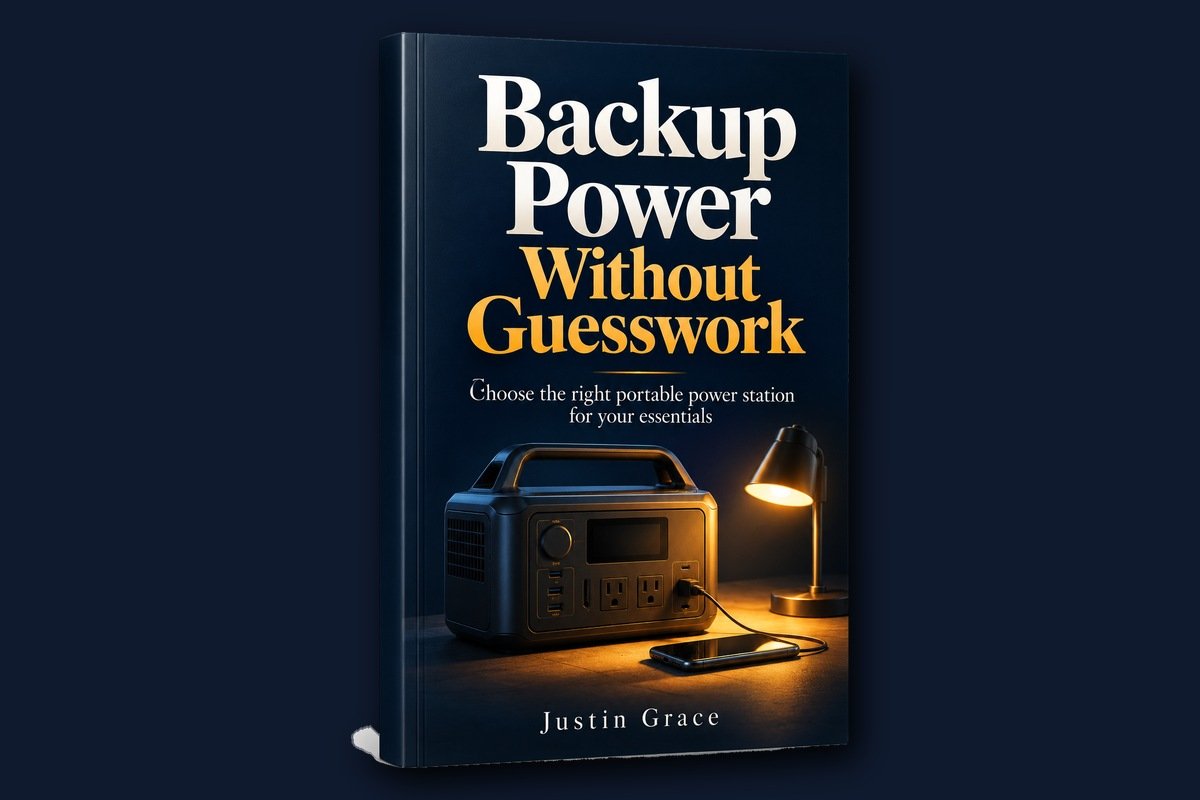
Backup Power Without Guesswork, by Justin Grace, develops this focused process for beginners choosing a portable power station for household essentials.
It explains how to define realistic operating times, assess simultaneous and startup demands, estimate energy needs, evaluate connections, and examine candidate specifications. It also covers overlooked purchasing details, including runtime claims, charging arrangements, special output modes, and questions requiring manufacturer confirmation.
Explore Backup Power Without Guesswork if you want the complete, plain-language process before choosing your first unit.
Start with one realistic outage period and the exact devices you want supported. Once that job is clear, you can judge output, usable energy, and connections against something concrete—and buy with a clear understanding of what your backup power is expected to do.
Want the complete step-by-step PDF?
Backup Power Without Guesswork by Justin Grace walks you through defining essentials, converting them into output / energy / connection requirements, and checking a shortlist before you pay — without hard-coded gear prices.
The full report is coming soon to our shop. In the meantime, join our free newsletter for practical home-preparedness tips and updates when new guides go live.
Prefer weekly ideas in your inbox? Join The Self-Reliant Life (free) via our newsletter page.